We look forward to showing you Velaris, but first we'd like to know a little bit about you.


Customer Retention Management: Strategies and Tools for Success
Learn customer retention management essentials, challenges, strategies, tools, and best practices.
The Velaris Team
March 6, 2026
Businesses often lose customers faster than they gain them, leading to high churn and missed growth. Customer retention management solves this by focusing on loyalty, lifetime value, and long-term success.
This article explains what retention means, the metrics to track, strategies to apply, and tools to use, giving you a clear path to stronger customer relationships from the ground up.
Key takeaways
- Retention means keeping customers loyal and engaged.
- Retaining customers costs less than acquiring new customers.
- Metrics like churn, CLV, and NPS show retention success.
- Challenges include poor onboarding, weak personalization, and inconsistent follow-ups.
- Strategies like great service, loyalty programs, and feedback improve retention.
What is customer retention management
Customer retention management is the practice of keeping existing customers engaged, satisfied, and loyal to a brand over time. It focuses on reducing churn, increasing repeat purchases, and maximizing customer lifetime value through consistent strategies and tools.
Why customer retention is more valuable than acquisition
Customer retention delivers stronger long-term value than acquisition because it focuses on loyalty and profitability rather than constant spending on new leads.
- Retention costs less: Acquiring new customers often requires heavy marketing and sales investments, while keeping existing ones is more cost-effective. The probability of selling to an existing customer is 60–70%, compared to 5–20% for new prospects. (Source: Marketing Metrics)
- Loyal customers generate higher lifetime value: Repeat buyers spend more over time, increasing overall revenue. Increasing retention by 5% can increase profit 25–95%. (Bain & Company)
- Repeat customers become brand advocates: Satisfied customers recommend products or services, driving organic growth and reducing reliance on paid advertising.
- Retention builds stability: A loyal base cushions businesses against market fluctuations and competition.
Best customer retention software
Velaris

- Unified inbox: Centralizes all customer conversations across email, chat, and social channels, ensuring faster responses and no missed requests.
- Customer segmentation: Groups customers by behavior, demographics, or purchase history, enabling highly personalized engagement strategies.
- Workflow automation: Automates loyalty programs, reward triggers, and retention workflows, saving time while keeping customers consistently engaged.
- Feedback dashboard: Collects customer feedback in real time and translates it into actionable insights for continuous improvement.
- Velaris, which is highly rated on G2, combines service, personalization, automation, and analytics in one platform, making it a complete retention solution rather than a single-purpose tool.
HubSpot Service Hub

- Ticketing system: Hubspot helps manage customer issues efficiently and ensures problems are resolved quickly.
- Feedback surveys: Allows businesses to measure satisfaction and identify areas for improvement.
- Automation tools: Provides reminders and follow-ups to keep customers engaged without manual effort.
- CRM integration: Works seamlessly with HubSpot CRM, giving businesses a unified view of customer data.
Zendesk

- Omnichannel support: Zendesk lets customers connect via email, chat, or social media for a seamless experience.
- Knowledge base: Offers self-service options that reduce support load and improve customer satisfaction.
- Analytics dashboards: Tracks customer satisfaction and support performance with clear reporting.
- Third-party integrations: Connects with a wide range of apps, making it flexible for different business needs.
Yotpo

- Loyalty and rewards: Yotpo helps businesses design and manage loyalty programs that encourage repeat purchases.
- Customer reviews: Collects and displays authentic reviews to build trust and credibility.
- SMS and email marketing: Provides tools for personalized communication that keeps customers engaged.
- Integrations: Works with major e-commerce platforms like Shopify, Magento, and BigCommerce.
- Ideal for e-commerce businesses that want to strengthen retention through loyalty programs, reviews, and direct customer engagement.
Salesforce Service Cloud

- Advanced CRM: Salesforce offers AI-driven insights to improve customer engagement and predict churn risks.
- Personalized communication: Enables tailored interactions across multiple channels.
- Case management: Streamlines customer service processes with automation and tracking.
- Scalability: Designed for large enterprises with complex retention and service needs.
Key metrics to measure customer retention
Customer retention rate (CRR)
Customer retention rate shows the percentage of customers who continue doing business with a company over a set period. It is a direct measure of loyalty and long-term engagement, helping businesses understand how effective their retention strategies are.
Customer churn rate
Churn rate measures the percentage of customers lost during a specific timeframe. Tracking churn helps identify patterns and reasons for attrition, allowing businesses to take corrective action before losses grow.
Customer lifetime value (CLV)
CLV calculates the average revenue a customer generates throughout their relationship with the business. It indicates the profitability of retention strategies and highlights which customer segments are most valuable.
Net promoter score (NPS)
NPS measures customer satisfaction and their likelihood to recommend a brand to others. It is a strong predictor of word-of-mouth growth and helps gauge overall customer loyalty.
Repeat purchase rate (RPR)
RPR tracks how often customers return to make additional purchases. A higher rate shows that the business is successfully encouraging ongoing engagement and building loyalty.
Customer satisfaction score (CSAT)
CSAT captures direct feedback from customers after interactions or purchases. It is useful for spotting service gaps and improving touchpoints that influence retention.
Average order value (AOV)
AOV measures how much customers spend per transaction. Higher values often signal stronger trust and loyalty, as customers are willing to invest more in the brand.
Customer engagement score
This composite metric evaluates customer activity, such as logins, clicks, or usage frequency. It indicates how actively customers interact with products or services, which is closely tied to retention.
Time between purchases
This metric calculates the average gap between repeat transactions. Shorter intervals suggest stronger retention, while longer gaps may signal disengagement.
Customer effort score (CES)
CES assesses how easy it is for customers to resolve issues or complete actions. Lower effort scores correlate with higher retention, as customers prefer seamless experiences.
Revenue churn
Revenue churn tracks the financial impact of cancellations or downgrades. It complements customer churn by showing how much revenue is lost, offering a clearer picture of retention performance.
Retention metrics that predict expansion
Traditional retention metrics tell you whether customers are staying, but they do not necessarily tell you whether an account is ready to grow.
Customer retention rate, logo churn, and revenue churn are useful for measuring whether revenue has been preserved, while expansion requires a different set of signals.
Benchmarkit's 2025 B2B SaaS benchmarks found expansion ARR contributed a median 40% of total new ARR, rising to 58% for $50M–$100M ARR companies. Clearly, expansion signals are very important to track.
Look for indicators of increasing value and deeper adoption. These might include growth in active users, broader feature adoption, more teams using the product, increasing usage of higher-value workflows, or a growing number of engaged stakeholders across the account.
These signals should be tracked separately from basic retention metrics. An account can renew successfully while remaining flat in usage and stakeholder engagement, which makes it retained but not necessarily expansion-ready.
Another account may still be months away from renewal while rapidly adding users and use cases, making it a stronger candidate for an expansion conversation.
Separating the two helps CS teams answer different questions. Retention metrics show whether existing revenue is protected, while expansion signals show where additional revenue may be developing.
Translating CS health scores into language Finance trusts
Customer Success and Finance often describe the same retention risk in very different ways. CS might say an account has moved from green to yellow because usage is falling and the champion has disengaged.
Finance needs to know what that means for expected renewal revenue, forecast confidence, and the amount of ARR genuinely at risk.
The first step is to translate health categories into explicit commercial scenarios. Instead of reporting that 20 accounts are “at risk,” connect each account to its ARR, renewal date, contract structure, and an agreed renewal probability.
This turns an operational health signal into a weighted revenue forecast that Finance can incorporate into planning.
The underlying drivers should remain visible. A declining health score caused by low adoption may imply a different level of commercial risk from one caused by an executive escalation, budget cuts, or confirmed competitive evaluation.
Documenting those drivers gives Finance a reason to trust the probability rather than treating the health score as a subjective CS judgment.
It also helps to track forecast accuracy over time. Compare the renewal probabilities assigned to accounts with what actually happened, then adjust the model where CS consistently over- or underestimates risk.
How to build a customer retention strategy from scratch
Creating a customer retention strategy is about building a clear, step-by-step plan that aligns with business goals and customer needs. By defining objectives, understanding your audience, mapping their journey, and using the right tools, you can design a system that keeps customers engaged and loyal over time.
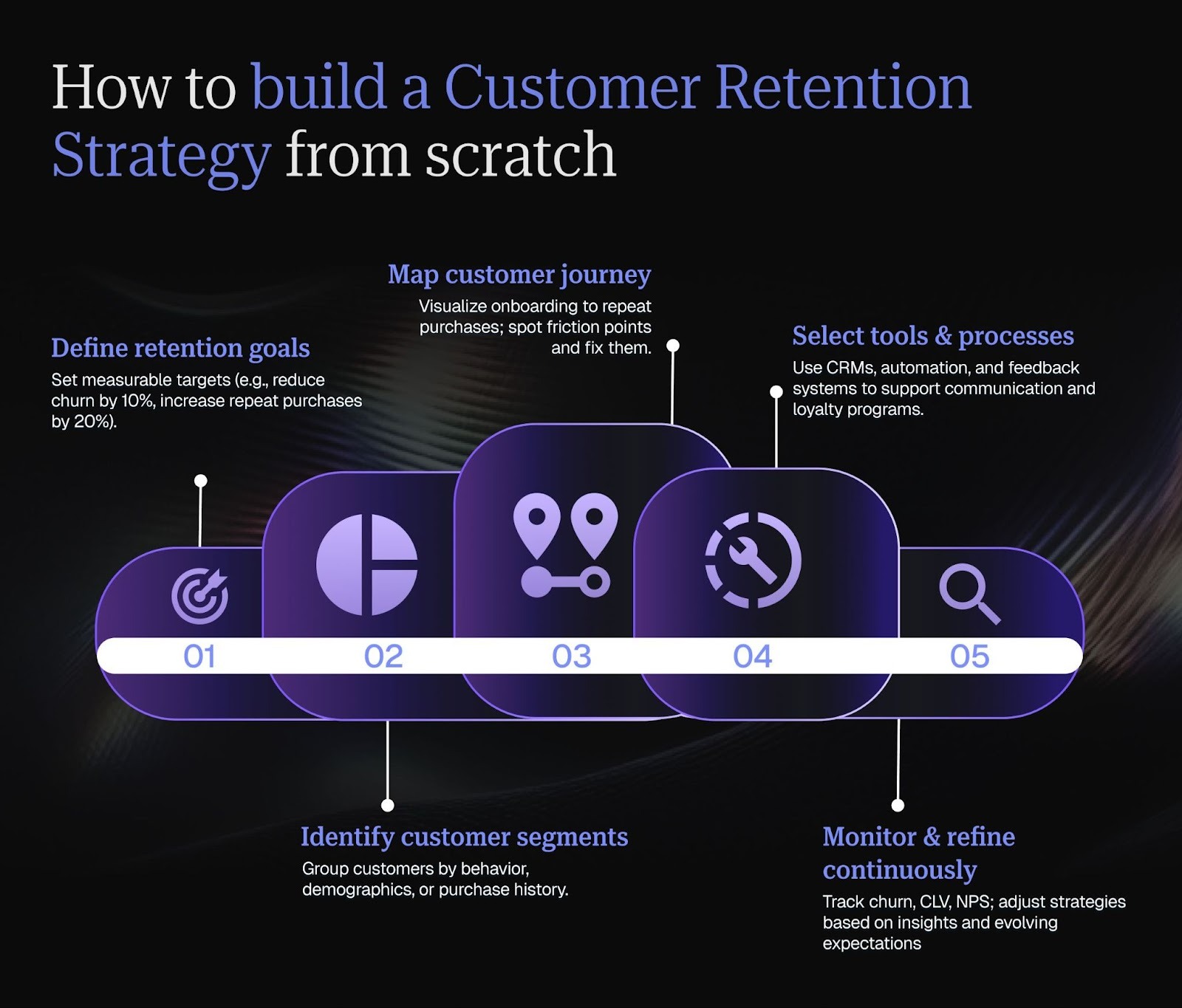
Define retention goals aligned with business objectives
Start by setting clear goals that connect retention efforts to overall business outcomes. For example, reducing churn by 10% or increasing repeat purchases by 20% ensures retention strategies are measurable and purposeful.
Identify customer segments and needs
Break down your customer base into segments based on behavior, demographics, or purchase history. Understanding each group’s needs helps tailor retention tactics that feel personal and relevant.
Map customer journey and pain points
Visualize the customer journey from onboarding to repeat purchases. Identify friction points where customers drop off or disengage, and design solutions to improve those experiences.
Strategize retention by contract structure
Customer retention strategy should reflect how the customer buys, not only who the customer is. A multi-year enterprise contract and a month-to-month SMB subscription create very different retention risks, even if both customers sit in the same segment.
For month-to-month customers, retention is continuous. Teams need to monitor usage, satisfaction, support friction, and engagement closely because the customer can leave with relatively little notice.
Retention motions should therefore be lightweight, frequent, and responsive to early warning signals.
Multi-year contracts create a different challenge. The customer may be contractually secure for another year or more while adoption, stakeholder support, or perceived value quietly declines.
In these accounts, retention work should focus on maintaining executive alignment, tracking progress against agreed outcomes, expanding stakeholder coverage, and preventing risk from accumulating until the renewal window.
Contract structure should also shape when teams intervene. Annual customers may need more deliberate checkpoints as renewal approaches, while multi-year accounts benefit from value reviews throughout the contract rather than a last-minute renewal push.
Using contract structure as a separate planning dimension helps CS teams build retention motions around the actual timing and nature of the commercial risk, instead of assuming every customer in the same segment should be managed the same way.
Select tools and processes to support retention
Choose the right mix of CRM systems, automation platforms, and feedback tools to streamline retention efforts. Processes like proactive communication and loyalty programs should be supported by technology for efficiency.
Monitor, measure, and refine strategy continuously
Retention is not a one-time effort. Track key metrics such as churn, CLV, and NPS regularly. Use insights to refine strategies, test new approaches, and adapt to evolving customer expectations.
Proven strategies to improve customer retention
Improving customer retention requires practical, repeatable actions that strengthen loyalty and reduce churn. By focusing on service, personalization, communication, and feedback, businesses can build long-term relationships that drive sustainable growth.
Delivering excellent customer service
Exceptional service builds trust and keeps customers coming back. Quick responses, helpful support, and consistent care create positive experiences that encourage loyalty.
Running structured account reviews
Consistent communication is easier to maintain when it has a clear structure. For B2B customer success teams, quarterly business reviews (QBRs) give both sides a regular opportunity to assess progress, surface emerging risks, and reconnect the relationship to the value the customer is receiving.
A retention-focused QBR should go beyond reporting activity. Review progress against agreed goals, highlight outcomes delivered since the last meeting, discuss changes in usage or engagement, and address unresolved issues before they become renewal blockers.
Gartner's April 2025 research aligns with this. It argues that QBRs should become purpose-driven strategic initiatives focused on existing and new business value targets, rather than retrospective performance reviews.
QBR’s are also a good opportunity to confirm whether the customer’s priorities have changed and whether the current success plan still reflects what they are trying to achieve.
Cadence should reflect account value and complexity. Strategic and enterprise accounts may warrant a formal quarterly review, while lower-touch customers can be managed through lighter business reviews, automated summaries, or less frequent check-ins.
The right stakeholders matter too. Customer-side attendees might include the champion, executive sponsor, admin, or other decision-makers, while the internal team may include the CSM alongside account management, support, product, or leadership where relevant.
Finally, feed the outcomes back into the account record. Changes in goals, stakeholder sentiment, risks, commitments, and adoption should update the health score and success plan so the QBR improves the team’s ongoing view of retention risk rather than becoming a standalone meeting.
Building loyalty programs and rewards
Rewarding repeat customers with discounts, points, or exclusive perks motivates them to stay. Well-designed loyalty programs turn occasional buyers into long-term advocates.
As for referral programs, they are usually treated as a growth tactic, but in B2B customer success they can also act as a useful signal of account health.
A customer who is willing to introduce you to a peer, another team, or another company is demonstrating a level of confidence that goes beyond a positive survey response.
That makes the referral ask useful as a retention health check as well as a source of pipeline. If a previously enthusiastic customer suddenly hesitates to make an introduction, it may be worth understanding whether satisfaction, perceived value, or internal sentiment has changed.
B2B referral programs should also be structured differently from consumer loyalty schemes. Instead of points or small rewards, incentives might include service credits, executive access, co-marketing opportunities, event invitations, or other benefits that are meaningful at the account level.
Timing matters. The strongest moments to ask for a referral are usually after the customer has experienced clear value, such as following a successful QBR, a positive renewal, an expansion, or the completion of a major milestone.
Maintaining consistent communication
Regular updates, check-ins, and reminders keep customers engaged. Consistent communication ensures customers feel connected and prevents disengagement over time.
Collecting and acting on customer feedback
Feedback reveals what customers value and where improvements are needed. Acting on insights shows customers their opinions matter, boosting satisfaction and retention.
Common challenges businesses face in retaining customers
Retaining customers is difficult because businesses often struggle with rising expectations, poor onboarding, lack of personalization, and inconsistent engagement. Addressing these challenges is essential to reduce churn and build long-term loyalty.
Rising competition and customer expectations
Customers today have more choices than ever, and they expect seamless experiences, personalized offers, and quick support. Businesses that fail to meet these rising expectations risk losing customers to competitors who deliver better value.
Poor onboarding or weak customer experience
A weak onboarding process or inconsistent customer experience often leads to early churn. If customers don’t see immediate value or face friction in using a product or service, they are less likely to stay engaged long term.
Lack of personalization in communication
Generic communication makes customers feel undervalued. Without personalization such as tailored recommendations or relevant offers businesses struggle to build meaningful relationships that encourage loyalty.
Losing your champion: stakeholder turnover as a retention risk
One of the most disruptive retention risks in B2B customer success is losing the person who understands the product, advocates for it internally, and helps keep adoption moving.
Unlike a usage drop, champion departure can happen suddenly and may not show up in product data until weeks later.
That makes stakeholder change something CS teams should actively monitor. Signals can include bounced emails, changes in job title or company on LinkedIn, updates to the account org chart, or a previously active contact suddenly disappearing from meetings and conversations.
When a champion leaves, the priority is to rebuild relationship coverage before the renewal gets close. Identify who has inherited their responsibilities, re-establish the customer’s goals and business case, and make sure the new stakeholder understands the value already delivered.
It also helps to widen the relationship beyond one person so the account is not dependent on a single advocate again.
Not every stakeholder change means the same thing. A champion who leaves the company creates a true continuity gap, while someone who moves to another team may still be reachable and able to introduce their replacement.
Your retention playbook should distinguish between those scenarios so the response matches the actual level of risk.
Inconsistent follow-ups or engagement
Retention requires ongoing effort. When businesses fail to follow up, check in, or engage customers consistently, relationships weaken. This lack of proactive communication often results in disengagement and eventual churn.
Conclusion
Metrics highlight patterns in customer behavior, reveal risks, and guide decisions that strengthen engagement and loyalty. Overcoming challenges and applying proven strategies further help reduce churn, ensuring customers stay connected. While acquisition is costly, retention delivers higher lifetime value and long-term advocacy.
Velaris, which is highly rated on G2, makes this process easier with features like a unified inbox for service, segmentation for personalization, automation for loyalty programs, and feedback dashboards for actionable insights. Ultimately, by setting clear goals, refining experiences, and leveraging the right tools, companies can build relationships that last.
Ready to see how Velaris can boost your retention? Request a demo today!
Frequently Asked Questions
What role does employee engagement play in retention?
Engaged employees deliver better service, which directly impacts customer satisfaction and loyalty. A motivated team often translates into higher retention rates.
How does retention impact brand reputation?
Strong retention leads to positive reviews, referrals, and word-of-mouth growth. Customers who stay longer are more likely to become advocates, boosting brand credibility.
What is the role of technology in modern retention?
Technology enables automation, personalization, and real-time analytics, making it easier to scale retention strategies without overwhelming teams.
How does retention tie into sustainability goals?
Retaining customers reduces the need for constant acquisition campaigns, lowering marketing waste and aligning with eco-friendly business practices.

The Velaris Team
A (our) team with years of experience in Customer Success have come together to redefine CS with Velaris. One platform, limitless Success.




Velaris is an AI-native Customer Success Platform built for mid-market and enterprise B2B SaaS teams. From customer health scoring and churn prediction to onboarding automation, renewals, and expansion workflows, Velaris helps recurring revenue teams understand account health, reduce churn, and scale customer success with greater visibility and control.