We look forward to showing you Velaris, but first we'd like to know a little bit about you.


10 Ways to Use AI for Customer Success
Explore 10 AI strategies customer success teams can use to enhance customer success and drive results. From customer sentiment analysis to churn prediction, AI is changing the way customer success teams operate.
The Velaris Team
July 17, 2026
AI can be used in customer success to reduce churn, improve engagement, and drive revenue growth. Many teams struggle with manual processes, delayed insights, and inconsistent customer experiences leading to missed opportunities and higher risk of attrition.
This article outlines 10 practical ways AI solves these pain points, showing how you can achieve proactive support, smarter forecasting, and scalable personalization to strengthen customer relationships and business outcomes.
Key takeaways
- AI shifts customer success from reactive support to proactive, data‑driven engagement.
- Generative AI automates communication, creating emails, playbooks, and meeting notes instantly.
- Automation reduces manual work with features like meeting summaries and success plan updates.
- AI analyzes feedback at scale, surfacing themes, sentiment, and opportunities for improvement.
- Predictive insights and dashboards help teams make smarter decisions and drive revenue growth.
1. Customer personalization
Customer personalization in AI means using data to give each customer a unique experience instead of a one‑size‑fits‑all approach. It ensures that every interaction from onboarding to ongoing support feels tailored to their specific needs and goals.
AI tailors onboarding, training, and engagement to each customer’s unique profile
Instead of giving every customer the same generic onboarding, AI looks at their industry, role, and product usage to design a journey that feels relevant. For example, a finance team might get workflows focused on reporting features, while a marketing team sees campaign automation first.
Dynamic recommendations based on product usage and behavioral signals
AI tracks how customers interact with the product in real time. If someone frequently uses a certain feature, it can suggest advanced tips or complementary tools. If usage drops, AI can recommend re‑engagement steps before the customer loses interest.
Personalized success plans aligned with customer business outcomes
Instead of vague “best practices,” AI helps create success plans tied directly to the customer’s goals like reducing costs, improving efficiency, or scaling operations. This ensures the customer sees measurable ROI and feels the product is solving their specific pain points.
2. Predictive customer health and churn prevention
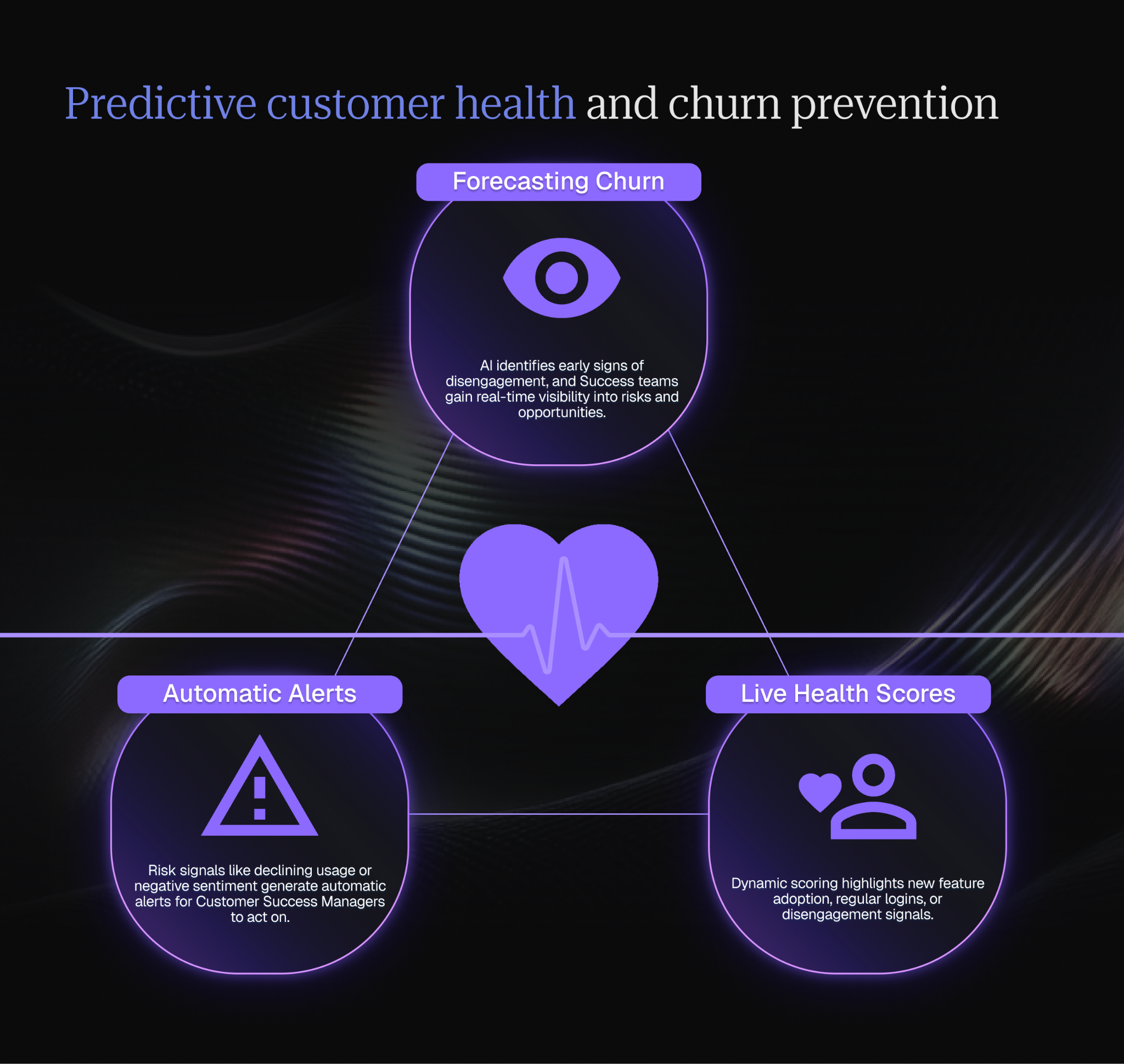
Predictive customer health means using AI to spot early signs of churn or disengagement before they become a problem. Instead of waiting for customers to cancel or complain, AI gives success teams real‑time visibility into risk and opportunities, so they can act proactively.
Predictive health is becoming a real CS use case, but it is not yet universal. In the Velaris’ 2026 State of AI in Customer Success report, 28% of teams said they use AI for predicting churn and expansion, while 27% use it to generate health scores.
AI models forecast churn risk before it becomes visible
AI analyzes product usage, engagement levels, and historical patterns to predict which customers are most likely to churn. This allows success teams to intervene early with targeted support or incentives.
Health scores updated in real time from product adoption metrics
Customer health isn’t static. AI continuously updates health scores based on how customers interact with the product whether they’re adopting new features, logging in regularly, or showing signs of disengagement.
Velaris, which is highly rated on G2 uses AI Pulse to take this further by providing dynamic health scoring that adapts instantly to customer behavior, giving CSMs a live pulse on account health.
Alerts trigger proactive outreach by CSMs
When AI detects risk signals such as declining usage or negative sentiment it automatically triggers alerts for Customer Success Managers. This ensures outreach happens at the right time, with the right context, to prevent churn and rebuild engagement.
When AI health scores contradict CSM gut instinct
If the score says an account is healthy but the CSM senses risk, the next step is to inspect the underlying signals. Look for gaps in the data, such as missing stakeholder changes, unresolved tension from recent calls, or risks that have not been logged yet.
The same applies when AI flags an account as risky but the CSM believes the relationship is strong. Review which signals drove the score and decide whether the model is detecting an early pattern or over-weighting one data point.
When there is disagreement, treat it as a review trigger. Document the reason, update any missing account context, and decide whether the health model needs adjustment.
3. Generative AI for customer communication
Generative AI in customer communication leverages intelligent tools to automatically create and refine messages, documents, and conversations. By doing so, it helps customer success teams save time, maintain consistency, and deliver clear communication across every touchpoint.
This growing impact is reflected in industry forecasts: The AI customer service market will reach $47.82 billion by 2030, with 95% of customer interactions expected to be AI-powered by 2025 (Full review;Servion Global Solutions).
Automated drafting of success emails, playbooks, and meeting notes
Generative AI can instantly draft personalized emails, structured playbooks, and meeting summaries. This is one of the more common AI use cases, with our report finding that 86% of teams use AI for generating content.
This reduces manual effort and ensures customers receive timely, well‑written communication that aligns with their success journey.
AI copilots assist CSMs with real‑time suggestions during calls
Velaris’s Copilot feature takes this further by providing Customer Success Managers (CSMs) with real‑time prompts, suggested responses, and contextual insights during customer calls. It acts like a live assistant, helping CSMs stay focused on the conversation while ensuring they don’t miss critical details or opportunities.
Consistent tone and messaging across customer touchpoints
Generative AI enforces brand voice and consistency across emails, chats, and documents. With Velaris Copilot, this consistency is built into every interaction, so customers experience a unified tone and style that builds trust and strengthens relationships.
Auditing AI-generated communications for brand-voice drift
When AI drafts a high volume of communications, the tone can start to sound a bit off. The content may be accurate but might still feel too inconsistent with how your team normally speaks to customers.
Create a simple review process for AI-generated communication. Sample messages regularly and check them against your brand voice, customer context, and relationship stage. Pay particular attention to sensitive moments like renewals and escalations.
Use the findings to update prompt guidance, approved templates, and examples of good communication. This keeps AI output consistent while still allowing CSMs to personalise the final message.
4. Proactive AI forecasting
Proactive AI forecasting helps customer success teams look ahead, not just back. It identifies risks and opportunities before they surface, allowing businesses to act early and guide customers toward better outcomes.
Moves beyond reporting to predicting customer needs and risks
Instead of only showing past performance, AI highlights what customers are likely to need next or where potential problems may arise. This gives success teams the chance to prepare solutions in advance.
Anticipates expansion opportunities based on usage trends
AI tracks how customers interact with products and spots patterns that suggest growth potential. For example, if a customer is heavily using advanced features, it may signal readiness for an upgrade or expansion.
Enables proactive success planning instead of reactive support
By forecasting risks and opportunities, AI empowers teams to design success strategies ahead of time. This shifts customer success from firefighting issues to guiding customers toward long‑term value.
5. Visual intelligence for customer experience
Visual intelligence uses AI to understand images, screenshots, and videos so customers get faster support and clearer guidance. It helps success teams solve problems quickly and makes self‑service experiences more intuitive.
AI interprets screenshots, product usage visuals, or error images
Customers often share screenshots or product visuals when reporting issues. AI can automatically analyze these images to identify errors, highlight relevant features, or suggest fixes without requiring lengthy explanations from the customer.
Faster troubleshooting with image/video recognition
Instead of relying only on text descriptions, AI recognizes patterns in images and videos to speed up problem resolution. For example, it can detect a misconfigured dashboard or highlight where a customer is stuck in the interface.
Enhances self-service portals with visual guidance
AI adds visual walkthroughs, annotated screenshots, and interactive guides to self‑service portals. This makes it easier for customers to solve issues independently, reducing support tickets and improving satisfaction.
6. AI for automating simple daily admin
AI helps customer success teams save time by automating routine admin tasks. There is some nuance to this; in our AI report 75% of respondents said their working hours stayed the same. But even if the hours are the same, there is a shift in the type of work when manual work is reduced: 49% said their role had become more strategic since adopting AI.
AI copilots integrated into daily workflows
AI copilots sit inside everyday tools like CRM systems, calendars, and communication platforms. They handle repetitive actions such as scheduling, updating records, or drafting quick notes, so success managers can spend more time on strategic work.
AI-powered meeting prep and follow-up
AI can help CSMs manage the full meeting workflow, not just the call summary. One CSM in our AI in CS report described using an onboarding agent to prepare for meetings, summarise calls, and draft follow-ups. Work that previously took 45–60 minutes now takes around 15 minutes to review and verify.
During the call, AI can capture notes and highlight important moments. After the meeting, it can draft follow-up emails, create tasks, assign owners, and track action items through to completion. This reduces manual admin and helps CSMs stay focused on the customer conversation.
Automated meeting summaries and success plan updates
AI generates clear summaries and updates success plans after calls. Velaris’s CallSense enhances this by transcribing conversations in real time, capturing key themes, and auto‑updating success plans with actionable insights saving CSMs time and ensuring nothing is missed.
AI-powered ticket and query routing
AI can classify inbound customer queries by topic, urgency, sentiment, and account context. This helps teams separate routine questions from issues that need faster attention.
Routing can also become more accurate. For example, an urgent query from a high-value account can be sent to the assigned CSM, while a product issue can go directly to the right support tier. This reduces manual triage and helps customers receive a faster first response.
Smart dashboards consolidate insights for faster decision-making
AI pulls data from multiple sources and presents it in unified dashboards. Success teams can instantly see customer health, engagement trends, and upcoming tasks, making decisions‑making faster and more accurate.
7. AI-driven success playbooks
AI‑driven success playbooks are automated guides that adapt to each customer segment. They give success teams clear, data‑backed steps to follow, reducing guesswork and ensuring consistent customer outcomes.
AI automatically generates tailored playbooks for each customer segment
Instead of manually creating strategies, AI builds playbooks that match the needs of different customer groups. For example, enterprise clients may get advanced adoption paths, while smaller teams receive simplified workflows.
Playbooks evolve in real time based on customer behavior and product adoption
AI continuously updates playbooks as customers use the product. If adoption slows or new features are embraced, the playbook adjusts instantly to reflect the customer’s current journey.
Success managers get guided next‑best actions to drive outcomes
AI highlights the most effective actions for Customer Success Managers (CSMs) to take at any given moment whether it’s scheduling a training session, suggesting an upgrade, or addressing a risk signal.
Reduces manual guesswork and ensures consistency across the success team
By standardizing playbooks, AI eliminates inconsistent approaches across different CSMs. Every customer receives a structured, proven path to success, which strengthens trust and accelerates results.
To find out about AI software specifically tailored for customer success, check out our article on the top 10 AI customer success tools.
8. Continuous feedback and experience improvement
Continuous feedback powered by AI helps companies listen to customers at scale. It turns surveys, reviews, and support interactions into actionable insights, so teams can detect issues early and improve the overall experience. Over 80% of customer feedback goes unused, but AI analytics can surface trends in real time.
AI analyzes surveys, reviews, and support tickets at scale
Instead of manually reading through thousands of responses, AI processes customer feedback across multiple channels. It identifies recurring themes, highlights pain points, and surfaces opportunities for improvement.
Velaris’s Trending Topics feature enhances this by automatically surfacing the most common issues and themes across surveys, reviews, and support tickets, giving success teams instant visibility into what matters most to customers.
Real-time sentiment tracking to detect dissatisfaction early
AI monitors customer sentiment in real time, spotting frustration or dissatisfaction before it escalates. This allows success teams to intervene quickly, preventing churn and strengthening trust.
Closed-loop feedback systems drive product improvements
With AI, feedback goes beyond collection and becomes a driver for improvement. By connecting insights directly to product teams, companies can prioritize fixes, launch new features, and continuously refine the customer experience.
9. AI-powered customer education and enablement
AI in customer education helps users learn faster and more effectively by tailoring training resources to their needs. It ensures customers get the right guidance at the right time, improving adoption and long‑term success. According to McKinsey enterprises adopting AI‑driven education tools report faster onboarding and improved retention, with AI personalization emerging as a key driver of customer success.
Personalized learning paths for customers based on product usage
AI analyzes how each customer uses the product and builds a learning path that matches their skill level and goals. Beginners receive step‑by‑step basics, while advanced users get deeper insights into complex features.
AI‑driven knowledge bases that adapt to customer queries
Knowledge bases become smarter with AI. Instead of static FAQs, they evolve based on customer questions, providing precise answers and surfacing the most relevant resources automatically.
Interactive training bots that guide customers step by step
AI‑powered bots act like virtual trainers, walking customers through processes in real time. They can answer questions, demonstrate workflows, and provide instant support without requiring human intervention.
10. Revenue growth through AI insights
AI helps companies grow revenue by spotting opportunities hidden in customer data. It identifies when customers are ready for upgrades, cross‑sells, or tailored offers, and forecasts future revenue based on behavior trends.
AI identifies upsell and cross‑sell opportunities
AI analyzes product usage patterns to detect when customers are likely to benefit from additional features or services. For example, if a team is maxing out its current plan, AI can suggest an upgrade before they ask.
Predictive analytics highlight accounts with expansion potential
By tracking adoption and engagement, AI pinpoints accounts that show signs of growth. Success teams can then prioritize these accounts for expansion conversations, ensuring they don’t miss high‑value opportunities.
Automated recommendations for tailored offers
AI generates personalized offers that match each customer’s needs. Instead of generic discounts, customers receive relevant suggestions that feel aligned with their goals, increasing the chance of conversion.
Revenue forecasting based on customer behavior trends
AI uses historical and real‑time data to forecast future revenue. This helps companies plan more accurately, allocate resources effectively, and set realistic growth targets.
Conclusion
AI is now the backbone of customer success, driving proactive, data‑led engagement across communication, forecasting, automation, feedback, and education. It reduces manual work, ensures consistency, and uncovers hidden opportunities.
For Customer Success Managers, this means more time for relationships and outcomes, while customers enjoy faster, personalized experiences and businesses gain stronger retention and scalable growth.
Velaris, which is highly rated on G2, brings this vision to life by embedding AI directly into customer success workflows. With features designed to anticipate needs, guide next‑best actions, and surface insights in real time, Velaris equips teams to act smarter, faster, and with greater confidence.
If you’re ready to elevate your customer success strategy, request a demo today and experience how Velaris can transform your approach to customer success.
Frequently Asked Questions
What types of customer data does AI analyze for insights?
AI can process surveys, support tickets, product usage logs, and reviews to identify trends, pain points, and opportunities for growth.
How does AI ensure accuracy in meeting summaries and success plans?
AI uses natural language processing (NLP) to capture key decisions, action items, and recurring themes, reducing the risk of human error or missed details.
Which AI use cases should CS teams prioritise by portfolio size?
It depends on portfolio scale. A team managing 50 enterprise accounts should prioritise AI for account intelligence, renewal risk, meeting prep, stakeholder mapping, and expansion signals because each account carries more relationship and revenue complexity.
A team managing 500 SMB accounts should prioritise scalable use cases such as automated onboarding, ticket routing, health alerts, customer segmentation, and self-service content. The larger the portfolio, the more AI should focus on triage and repeatable workflows.
What are the biggest challenges in adopting AI for customer success?
Common challenges include data quality, change management, and ensuring teams trust AI recommendations. Make sure your data is clean and structured before rolling out AI. As for team adoption, they are more likely to adopt AI when it supports existing workflows, explains the signals behind its suggestions, and keeps humans in control of sensitive customer decisions.
Is AI in customer success secure and compliant?
Most platforms use enterprise‑grade security and compliance standards. The key is ensuring customer data is handled responsibly and transparently.

The Velaris Team
A (our) team with years of experience in Customer Success have come together to redefine CS with Velaris. One platform, limitless Success.




Velaris is an AI-native Customer Success Platform built for mid-market and enterprise B2B SaaS teams. From customer health scoring and churn prediction to onboarding automation, renewals, and expansion workflows, Velaris helps recurring revenue teams understand account health, reduce churn, and scale customer success with greater visibility and control.