We look forward to showing you Velaris, but first we'd like to know a little bit about you.


Using AI for Smarter Customer Satisfaction Management
Learn how AI helps Customer Success Managers tackle challenges like sentiment analysis, health scoring, and prioritizing customer data.
The Velaris Team
January 28, 2026
AI improves customer satisfaction management by analysing customer sentiment, unifying feedback across channels, and helping Customer Success teams act on dissatisfaction before it turns to churn. This approach is most valuable for Customer Success Managers (CSMs) and CS leaders managing growing account volumes, fragmented data, and delayed feedback signals that make it hard to prioritize work.
In this blog, we’ll explore how AI transforms customer satisfaction management, offering practical solutions for CSMs to stay ahead. From sentiment analysis to automating health scoring, you’ll discover strategies to use AI effectively, and how tools like Velaris, a highly rated platform on G2, make it possible.
Key takeaways
- AI helps Customer Success teams detect dissatisfaction early, before it turns into churn.
- Manual methods break down at scale. AI becomes essential as account volumes and data sources grow.
- AI unifies sentiment across emails, tickets, calls, and chat into a single, actionable view.
- Real-time, AI-driven insights enable proactive intervention instead of reactive struggling.
- Predictive signals help teams prioritize risk, renewals, and expansion more effectively.
- Velaris unifies data into one AI-driven view, using Trending Topics, Call Sense, and AI Pulse. It helps surface common issues, detect risk early, and help teams act on customer satisfaction before it turns into churn.
Why does AI matter for customer satisfaction?
When it comes to understanding customer health, traditional methods can fall short, leaving Customer Success Managers (CSMs) struggling to address issues before they become bigger problems.
Let’s take a closer look at the specific challenges of traditional customer health scoring and the impact it has on customer satisfaction.
Difficulty tracking customer sentiment
Customers communicate through emails, chat, calls, and even social media. Without a unified system, it becomes nearly impossible to track sentiment consistently across these channels, leading to missed signals of dissatisfaction.
Unresolved pain points can quickly lead to frustration, prompting customers to leave for competitors who offer a better experience.
Harvard Business Review’s study found that just using CSAT and NPS surveys don’t convey what the customer is actually feeling.
That’s why they adopted an AI linguistics-based model and combined it with traditional rating scales to obtain deep insights into customer sentiment. These insights can directly shape both short-term and long-term actions to retain customers.
Lack of real-time insights into customer behavior and satisfaction levels
Traditional health scoring methods rely on historical data that may no longer reflect the customer’s current experience. This delay in information makes it harder to identify and address pain points promptly.
Without timely insights, CSMs can’t intervene until after dissatisfaction has escalated. At that point, it’s often too late to repair the relationship.
Overwhelming amounts of data
With data scattered across different tools and platforms, CSMs spend more time sifting through information than acting on it. This inefficiency limits their ability to prioritize tasks and focus on customers who need immediate attention.
Disconnected systems prevent teams from having a shared understanding of customer health, creating gaps in communication and inconsistent customer experiences.
Recognizing these challenges is the first step toward addressing them. In the next section, we’ll explore how AI can help CSMs overcome these obstacles by streamlining processes, providing real-time insights, and enhancing customer satisfaction.
How can AI solve key challenges in customer satisfaction management?
AI helps Customer Success teams close visibility gaps and act faster by continuously analysing customer signals, unifying fragmented data, and prioritising action before dissatisfaction turns into churn.
There has been real evidence of AI’s success solving key challenges in industries. Research from McKinsey & Company shows that many organizations that implement AI in their workflows show an increase in customer satisfaction levels.
Let’s explore further how AI addresses common CSM pain points effectively.
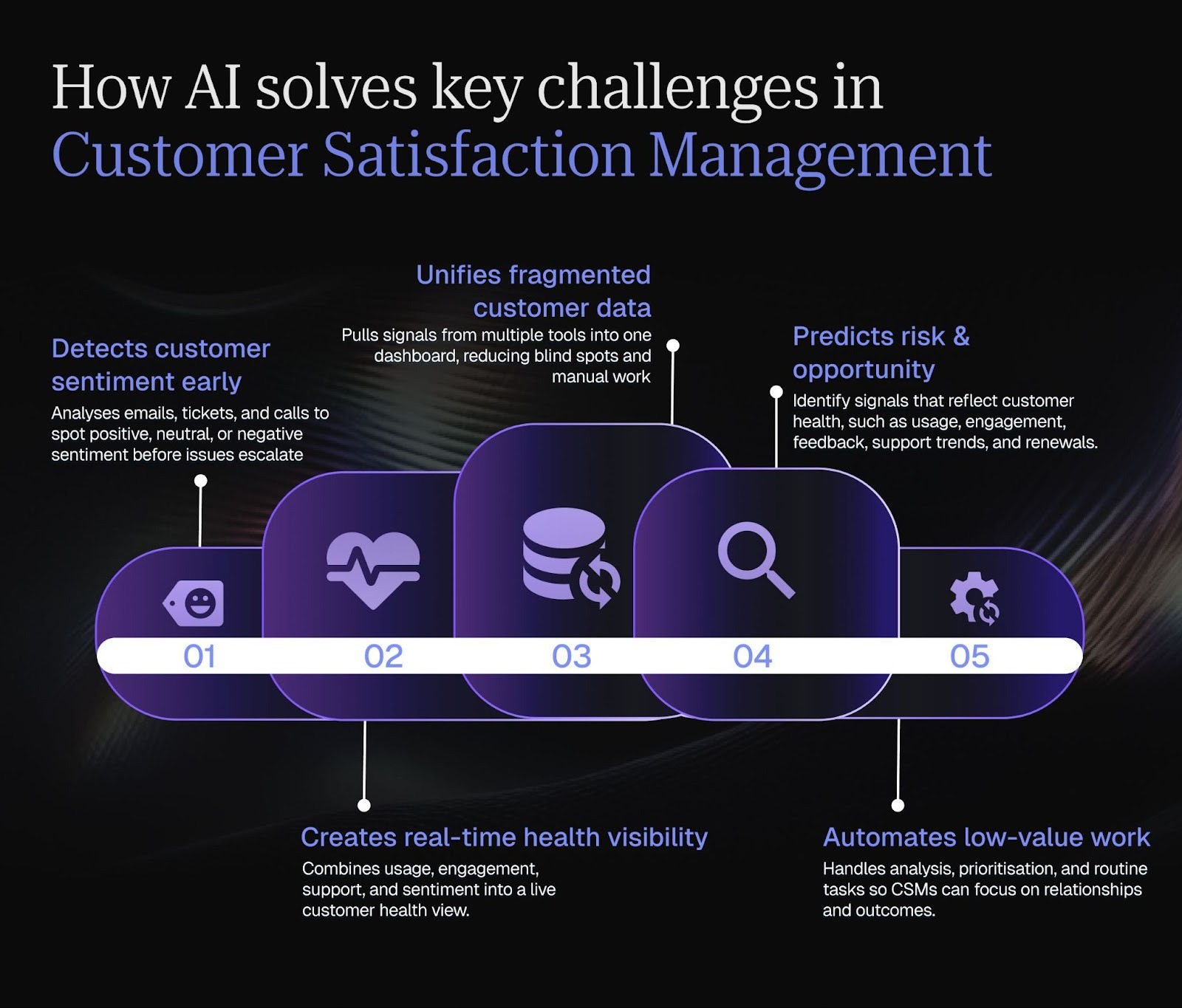
AI-driven customer sentiment analysis
AI can analyze customer emails, support tickets, and call transcripts to identify sentiment trends by processing language cues and tone, AI helps identify when customers are happy, neutral, or dissatisfied.
Velaris’s sentiment analysis uses AI to flag customer emails and messages with sentiment and suggests next steps. With this, you can rely on AI to analyze communication trends and prioritize tasks based on urgency.
Instead of reacting to churn signals after the fact, AI empowers CSMs to take preemptive action, improving the customer experience and retaining more accounts.
Real-time insights into customer health scoring
AI aggregates customer data from multiple sources to create a comprehensive health score. Whether it’s engagement metrics, usage data, or support tickets, AI centralizes this information to give CSMs a complete picture of customer health.
It can also track behavioral trends, purchase history, and sentiment for actionable insights. Real-time tracking allows CSMs to identify patterns and tailor their approach to meet individual customer needs, improving overall satisfaction.
AI-powered data integration and analysis
AI tools integrate data from previously siloed systems, creating a centralized view of customer behavior and feedback.
For example, AI can bring together metrics from support, sales, and marketing platforms into one cohesive dashboard, making it easier to see the full picture. AI also excels at processing large datasets quickly and efficiently, so it can analyse customer interactions efficiently.
This unified approach not only reduces time spent on manual data aggregation but also ensures decisions are based on accurate, up-to-date information.
AI-based predictions for customer satisfaction
AI’s ability to analyze data and identify patterns makes it a powerful tool for predicting customer satisfaction outcomes. By examining past behaviors, engagement trends, and sentiment shifts, AI provides you with actionable forecasts to make proactive decisions.
For example, AI could potentially forecast customer lifetime value (CLV) by examining historical purchase behaviors, upsell patterns, and overall engagement levels. This insight helps teams prioritize their efforts on high-value accounts and allocate resources effectively.
Additionally, AI may be able to predict feature adoption and upsell opportunities by analyzing customer usage data. This ensures CSMs can offer tailored recommendations and targeted support, driving further growth and engagement within accounts.
These predictive capabilities not only identify risks, but also help teams seize opportunities to create value for customers.
Automating repetitive tasks to focus on high-value activities
AI can handle data entry, email drafting, and progress tracking. By automating mundane tasks, AI frees up time for CSMs to focus on strategic initiatives like building relationships and addressing critical accounts.
With less time spent on manual work, CSMs can dedicate their attention to engaging with customers, resolving issues, and fostering loyalty.
In the next section, we’ll discuss best practices for implementing AI in your customer satisfaction strategy, ensuring you get the most value out of these tools.
Best practices for implementing customer satisfaction AI
Implementing AI into your customer satisfaction strategy requires more than just adopting a new tool. Here are a few best practices to help you set up AI effectively for managing customer satisfaction.
Standardize your processes first
Ensure your CS processes are consistent and well-documented. AI works best when it’s applied to a structured environment. Before adopting AI, take the time to map out and document your Customer Success processes to ensure they’re standardized across your team.
Use playbooks with in-built checklists to guide your team and maintain alignment. Playbooks help keep your team aligned by defining clear steps for common scenarios.
Velaris has customizable playbooks that can not only streamline workflows, but also make it easier for AI to integrate and enhance your processes.
Focus on customer sentiment and engagement metrics
Identify key metrics like NPS, CSAT, and CES to measure satisfaction. Establishing a baseline for customer sentiment and engagement is critical. These metrics provide a clear starting point for understanding how satisfied customers are and where improvements are needed.
You can also use AI-driven surveys to gather feedback and analyze responses in one place. AI can simplify the process of collecting and analyzing feedback.
By automating surveys and consolidating responses into a single platform, AI helps you gain actionable insights more efficiently.
Unite your data for a holistic view
Integrate tools across sales, marketing, and support for unified data collection. Customer data often exists in silos, making it difficult to get a full picture.
Integrating tools ensures all relevant customer interactions are centralized, providing AI with the data it needs to deliver meaningful insights.
For this, you need to ensure that AI has access to all relevant touchpoints for accurate analysis. The more touchpoints AI can analyze, the better it can understand customer behavior and sentiment. Make sure your systems are fully connected to give AI a complete view.
By following these best practices, you’ll set the stage for successful AI implementation.
When should teams use AI for customer satisfaction?
Customer Success teams should use AI once manual methods can no longer keep up with customer scale, complexity, and speed. If surveys, spreadsheets, or intuition surface issues only after customers are already unhappy, AI becomes necessary to detect risk earlier and act in time.
There are a few clear signals that indicate when this shift is needed:
- Account volumes outgrow manual review: As CSMs manage dozens or hundreds of customers, reviewing every email, ticket, and call manually stops being realistic. AI continuously monitors communication and sentiment, helping teams prioritize what they give attention to.
- Customer communication spans multiple channels: When feedback is spread across email, support tickets, calls, and chat, sentiment becomes fragmented. AI unifies these signals into a single view, reducing blind spots and making dissatisfaction easier to spot.
- Renewals feel reactive instead of proactive: If churn risk only becomes visible late in the renewal cycle, AI can identify declining engagement, negative sentiment, or early warning signs months earlier. This gives teams time to intervene and protect retention.
- Teams are busy, but the outcomes are missing: When CSMs spend more time gathering data than acting on it, AI helps shift effort toward higher-impact work by automating analysis, prioritization, and routine tasks.
At this stage, AI is less about experimentation and more about enabling sustainable, proactive customer satisfaction management. If you're evaluating which platforms to consider, see our roundup of the top AI customer success tools and how they compare across key capabilities.
What AI cannot replace in customer satisfaction management
AI strengthens customer satisfaction management by improving visibility and speed, but human judgement remains essential for context, relationships, and decision-making.
The best use for AI is as an augmentation layer, not a replacement for human judgement. Understanding where AI stops adding value is just as important as knowing where it excels.
Why AI does not replace CSM judgement
AI is strong at identifying patterns, anomalies, and trends across large volumes of data. What it cannot do is fully understand business context, relationship history, or strategic nuance. A CSM’s judgement is still essential when interpreting why a customer feels a certain way, how internal politics may influence decisions, or when short-term dissatisfaction is acceptable in service of a longer-term goal. AI can flag risk, but deciding how to respond remains a human responsibility.
Where human context still matters
Customer satisfaction is influenced by factors that rarely appear in data alone, such as stakeholder changes, budget cycles, internal priorities, or informal feedback shared off-record. CSMs often have insight into these dynamics through conversations and experience that AI cannot access or interpret reliably. This context is critical for choosing the right timing, message, and action when addressing customer concerns.
Common mistakes teams make when adopting AI
One of the most common mistakes is treating AI outputs as absolute truth rather than decision support. Over-automating responses, acting on sentiment without validation, or applying AI-driven workflows without clear process ownership can erode trust internally and externally.
Teams also struggle when AI is introduced before processes are standardised, leading to noisy signals and inconsistent outcomes. The most successful teams use AI to inform decisions, but don’t use it as an excuse to replace accountability or critical thinking.
How Velaris helps teams manage customer satisfaction
Velaris helps Customer Success teams move from fragmented signals to a clear, shared understanding of how customers actually feel.
Identifying common customer issues with Trending Topics
Trending Topics by Velaris automatically analyses customer emails, messages, and feedback to surface recurring themes across accounts. Rather than reviewing individual comments one by one, teams can see which issues appear most often, such as product friction, onboarding gaps, or support delays.
Detecting risk and opportunity in meetings with CallSense
CallSense analyses customer meetings and calls to identify sentiment, hesitation, and signals of risk or expansion. It highlights key moments in conversations that might otherwise be missed in notes, giving CSMs better context for follow-ups and helping teams understand what’s happening across accounts without listening to every recording.
Monitoring sentiment trends with AI Pulse
AI Pulse provides a real-time view of customer sentiment and health trends across the customer base. By continuously analysing signals from communication, usage, and feedback, it helps teams spot shifts in satisfaction early.
Collecting and analysing surveys in context
Velaris supports structured feedback collection through surveys such as NPS and CSAT, which can be automated and targeted to specific customer segments. Survey responses are analysed alongside conversational data, ensuring feedback does not remain in isolation but contributes to a more complete view of customer satisfaction.
By combining surveys, conversational intelligence, and AI-driven pattern detection, Velaris helps Customer Success teams spend more time acting on what customers are really telling them.
Conclusion
AI is changing the way Customer Success Managers (CSMs) approach their work. By automating routine tasks, providing real-time insights, and enabling proactive customer care, AI allows CSMs to focus more on building strong, lasting relationships with their customers.
Adopting AI-powered tools can simplify how you manage customer satisfaction. From tracking sentiment and engagement metrics to creating dynamic health scores and streamlining communication, these tools offer practical solutions that address the challenges CSMs face every day.
If you’re looking to enhance customer satisfaction and reduce churn by leveraging AI in your workflows, Velaris, a highly rated platform on G2, could be the tool you need. Book a demo today to see how Velaris can help you deliver the insights and efficiency your team needs to succeed.
Frequently Asked Questions
How is AI-driven customer satisfaction different from traditional CSAT or NPS?
AI looks beyond survey scores by continuously analysing customer conversations and behaviour. It captures sentiment signals that surveys often miss or surface too late.
Do small Customer Success teams benefit from AI, or is it only for scale?
Smaller teams benefit when customers communicate across multiple channels or when manual tracking starts consuming too much time. AI reduces cognitive load even before headcount or accounts grow significantly.
How accurate is AI at understanding customer sentiment?
AI is effective at detecting patterns and shifts in tone across large volumes of communication. It works best when used as an early signal, validated by CSM context rather than treated as absolute truth.
Can AI help identify expansion opportunities, not just churn risk?
Yes. Positive sentiment, increased engagement, and strong adoption patterns can signal readiness for upsell or cross-sell when combined with account context.
What data does AI need to work effectively for customer satisfaction?
AI performs best when it has access to customer communications, engagement data, and usage signals. The more connected and consistent the data, the more reliable the insights.
Will AI replace customer conversations or check-ins?
No. AI supports better conversations by helping CSMs know where to focus and what to address. Relationship-building and strategic discussions still require human interaction.
How long does it take to see value from AI in customer satisfaction?
Teams often see early value within 2–4 weeks once AI is connected to core data sources and workflows. More consistent, measurable impact typically follows within 2–3 months, as processes are standardised and AI insights are embedded into daily workflows and decision-making.
What’s the biggest mistake teams make when adopting AI for satisfaction management?
Relying on AI without clear processes or accountability. AI should guide action, not automate decisions without human review or ownership.

The Velaris Team
A (our) team with years of experience in Customer Success have come together to redefine CS with Velaris. One platform, limitless Success.




Velaris is an AI-native Customer Success Platform built for mid-market and enterprise B2B SaaS teams. From customer health scoring and churn prediction to onboarding automation, renewals, and expansion workflows, Velaris helps recurring revenue teams understand account health, reduce churn, and scale customer success with greater visibility and control.