We look forward to showing you Velaris, but first we'd like to know a little bit about you.


10 Ways to Use AI to Boost Customer Retention
Uncover how AI can boost customer retention with predictive insights, automated workflows, and personalized engagement strategies.
The Velaris Team
July 22, 2026
This guide breaks down ten specific ways AI gives Customer Success Managers and CS leaders the tools to detect churn earlier, personalize at scale, and free up time for the relationships that actually drive retention.
It's built for CS teams managing large portfolios who are under pressure to do more with the same headcount, and for leaders who need to move their function from reactive firefighting to proactive strategy.
Use it when you're evaluating where AI fits into your CS motion, building the case for a purpose-built platform, or looking for concrete starting points to drive measurable retention improvements.
Key Takeaways
- AI boosts customer retention by surfacing churn risk early. Predictive analytics flags accounts showing declining engagement before problems escalate, giving CSMs time to intervene rather than react.
- Personalized, behavior-triggered communication reduces churn. Companies using generative AI in customer workflows have seen up to a 25% churn reduction through hyper-personalized outreach at scale.
- AI health monitoring replaces manual portfolio reviews. Real-time health scores and automated alerts let CS teams catch subtle account shifts across large books of business without relying on quarterly check-ins.
- Faster onboarding directly improves long-term retention. AI-guided onboarding has reduced time-to-value by 30% in SaaS implementations, and companies using it commonly achieve net revenue retention above 110%.
- AI-powered upsell detection turns expansion into a retention lever. Companies using AI personalization generate 40% more revenue than slower adopters, and expanding customers are the least likely to churn.
- AI feedback analysis closes the loop between customer signals and CS action. By aggregating sentiment across tickets, surveys, and in-app behavior, AI identifies churn-correlated themes that manual analysis consistently misses.
Here are ten ways AI is transforming how teams retain and grow their customer base.
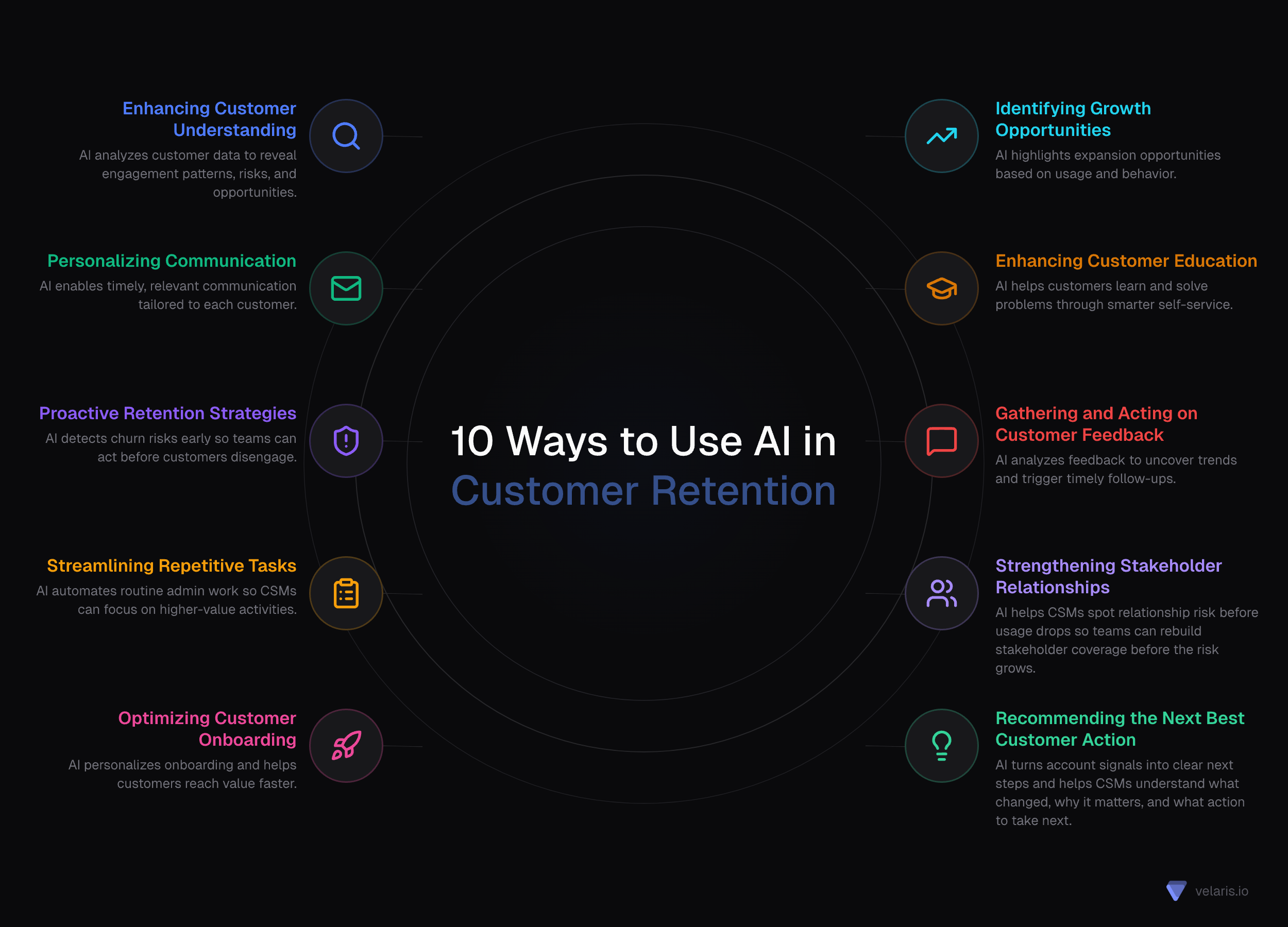
If you’re looking for software that can help you use AI to its fullest potential, check out this blog on the top 10 AI customer success tools.
1. Enhancing Customer Understanding with AI-Powered Data Insights
You can't retain customers you don't understand. AI gives CS teams a real-time, data-driven view of every account, surfacing patterns in behavior, engagement, and satisfaction that would take hours to uncover manually. The result is a sharper, more complete picture of where customers are thriving and where they're at risk.
This is exactly the kind of visibility that G2 users say a purpose-built CS platform like Velaris provides.
Predictive Analytics
AI can build and apply churn prediction models that flag accounts before problems escalate. If a customer's login frequency drops, their support tickets spike, or their product adoption stalls, AI can surface that risk early, giving CSMs time to intervene with targeted outreach instead of scrambling after it’s too late.
As research on predicting customer churn with AI shows, acquiring new customers is far more expensive than retaining them, which makes early detection both a strategic advantage and a financial imperative.
In addition, this article from G2 highlights how organizations are increasingly relying on AI-driven insights to identify churn risks earlier and take proactive steps.
By identifying at-risk accounts before problems escalate, predictive analytics turns a reactive scramble into a proactive play.
Customer Communications Insights
AI can analyze customer communications like emails, tickets, chat logs to identify trending topics, recurring questions, and emerging friction points. If multiple accounts are asking about the same feature or hitting the same wall, that's intelligence your team can act on proactively, and at scale.
These insights also help CSMs personalize their conversations by knowing what matters most to each account before they even pick up the phone.
Sentiment Analysis
Not every unhappy customer will tell you they're unhappy, but their tone often will. AI-powered sentiment analysis scans customer messages and flags accounts displaying negative or declining sentiment, so CSMs can prioritize their outreach to the customers who need attention most. It's a fast and reliable way to make sure dissatisfaction doesn't go unnoticed until it's too late.
As AI sentiment analytics research confirms, proactively responding to emotional cues rather than waiting for customers to voice explicit complaints is one of the most effective ways to strengthen loyalty and prevent silent churn.
Velaris does this natively with its Headlines and CallSense features.
Dynamic Customer Segmentation
Static customer segments based on contract size or industry are a starting point, but they quickly become outdated. AI enables dynamic segmentation by behavior that updates in real time based on actual behaviors like usage depth, feature adoption, engagement frequency, and health scores.
This means your team is always working from an accurate, current view of each account's needs and risk level, and not a snapshot from six months ago.
The above use cases are already emerging in CS teams. Velaris’ State of AI in Customer Success report found that 35% of teams said they use AI to analyse customer feedback, 28% use it to predict churn and expansion, and 27% use it to generate health scores.
2. Personalizing Communication to Keep Customers Engaged
Generic communication is noise. Customers who feel like they're receiving the same email as everyone else are far less likely to engage and far more likely to churn. AI makes it practical to deliver relevant, timely communication to every account without overwhelming your team.
Automated Messaging
AI-powered automated messaging lets CSMs set up behavior-triggered or time-based sequences that reach customers exactly when they're most relevant, whether that's a check-in after a missed milestone, a usage tip when adoption drops, or a renewal reminder at the right moment in the customer lifecycle.
The messages go out automatically, but they feel intentional.
AI-Assisted Content
Content generation is currently the most common AI use case in customer success. Our AI in CS report found that 86% of teams use AI to generate content, making it the clearest entry point for teams using AI to personalise customer communication.
Crafting personalized communication like QBR follow-ups, EBR invitations, and product updates for dozens or hundreds of accounts is one of the biggest time sinks in CS.
According to research on generative AI and churn reduction, companies using generative AI in customer experience workflows have seen up to a 25% decrease in churn through hyper-personalized support, while a Salesforce report found that 68% of service professionals say it helps them retain customers through more meaningful interactions.
AI writing assistants can generate first drafts tailored to the customer's context, industry, and recent activity, while CSMs review and send rather than writing from scratch. This applies across the full range of customer communications, from email campaigns to renewal outreach and EBR follow-ups.
Predictive Content Delivery
AI doesn't just help you craft the right message, it also helps you send it at the right time, and through the right channel. By analyzing when customers typically engage with communications, how they prefer to be contacted, and what content resonates with similar accounts, AI can recommend the optimal delivery approach for each customer.
This precision makes outreach more effective and strengthens the overall customer relationship.
3. Proactive Retention Strategies Through AI-Driven Alerts and Predictions
The most effective retention strategy is one that kicks in before a customer even considers leaving. AI enables a fundamentally proactive approach like continuously monitoring customer health and alerting CSMs to risks the moment they emerge, and not after they've already caused damage.
Predictive Retention Models
AI-driven retention models analyze historical data from churned and retained accounts to identify the behavioral patterns that precede disengagement. When a current customer starts showing those same signals, the model flags the risk automatically, and CSMs receive alerts in time to intervene with personalized outreach before a renewal conversation becomes a recovery conversation.
Velaris' AI surfaces these signals in real time, flagging risks, detecting opportunities, and generating action items so that CSMs receive the right alert at the right moment.
Health Monitoring
AI-powered health monitoring tracks customer interactions continuously across every data source and rolls them up into a real-time health score for each account.
Unlike manual portfolio reviews, AI can catch even subtle shifts across a large book of business, triggering alerts when patterns warrant attention. CSMs can act quickly rather than discovering problems during a quarterly check-in.
Automated Renewal Forecasting
AI removes the guesswork from renewal planning. By analyzing health scores, engagement trends, contract history, and usage data, AI can forecast renewal likelihood for every account long before the renewal date arrives.
This gives CS leaders visibility into where revenue is at risk, which accounts need immediate attention, and how to prioritize team capacity across the portfolio.
It also makes pipeline reporting far more accurate and actionable.
Recalibrate retention models as you move upmarket
AI retention models can lose accuracy when your ideal customer profile changes. A model trained on SMB accounts may treat usage frequency as the strongest churn signal, but enterprise accounts often behave differently.
As the company moves upmarket, review which signals the model relies on. Recalibrate for factors such as stakeholder coverage, executive engagement, implementation complexity, support severity, contract size, and success-plan progress.
When the AI signal contradicts the CSM's read on the account
When the model flags risk but the CSM believes the relationship is healthy, the first step is to inspect the signals behind the alert. Check whether the model is reacting to a real pattern, such as lower usage or reduced stakeholder engagement, or whether it is over-weighting one unusual event.
The reverse can also happen. A CSM may feel confident because the relationship is friendly, while AI detects declining adoption or fewer product interactions. In that case, treat the alert as a prompt to validate the account rather than dismiss it.
The best approach is to document the disagreement, review the evidence, and decide on a next step. That might mean updating missing account context or running a proactive check-in with the customer.
4. Streamlining Repetitive Tasks So CSMs Can Focus on Strategic Retention
The most impactful work a CSM can do—building relationships, solving complex problems, driving strategic value—gets crowded out when too much time goes to administrative tasks. AI addresses this directly by automating the routine work, freeing CSMs to operate at the level that actually moves the needle on retention.
Workflow Automation
From scheduling follow-ups and updating CRM records to sending routine check-in messages and logging customer interactions, AI handles the tasks that are necessary but time-consuming.
Automating these workflows ensures consistency across every customer touchpoint, and CSMs don't have to spend mental energy remembering to do things that a system can do reliably.
AI Playbooks
AI-powered playbooks bring structure and consistency to retention-critical processes. Rather than relying on tribal knowledge or individual CSM habits, playbooks provide step-by-step guidance that ensures best practices are followed across the entire team.
For CS leaders, this means more predictable outcomes and a faster path to getting new team members up to speed.
AI Meeting Notes and Summaries
Capturing accurate meeting notes, extracting action items, and updating account records after every customer call is important, but it pulls CSMs out of the conversation and into admin mode.
AI meeting tools transcribe calls in real time, surface key themes and commitments, and generate summaries that can be logged directly to the customer record. CSMs stay present in the conversation, and the documentation happens automatically.
Velaris' CallSense feature does exactly this: it transcribes calls, extracts action items, generates ready-to-send follow-up emails, and logs everything directly to the account record so the conversation stays human, and the admin takes care of itself.
Route AI retention signals across teams
AI retention alerts should not automatically go to every team in the same way. A drop in usage may require a CSM check-in, a product investigation, and a sales note before renewal, but each team needs a different action.
Define routing rules for common signals. Product adoption issues may go to CS first, with Product looped in if the pattern appears across multiple accounts. Expansion signals may go to the CSM and account executive together. Repeated product complaints should be routed to Product with customer context attached.
This prevents the same alert from being triaged three different ways. It also makes AI more useful because each signal has a clear owner, next step, and feedback loop.
5. Optimizing Customer Onboarding with AI-Guided Journeys
Retention starts at onboarding. Customers who reach their first value milestone quickly are significantly more likely to renew and expand. AI helps CS teams design and deliver onboarding experiences that get customers to that moment faster and more consistently, regardless of account size or complexity.
Personalized Onboarding Paths
Not every customer needs the same onboarding experience. AI can tailor the journey based on the customer's use case, team size, technical maturity, and stated goals, thereby surfacing the right resources, tasks, and check-ins at each stage.
This means faster time-to-value for customers and less time spent by CSMs manually customizing onboarding plans from scratch, a gap that automating onboarding closes quickly.
AI onboarding metrics research shows that one SaaS company reduced time-to-value by 30% after introducing an AI-powered onboarding assistant, and companies using AI for onboarding commonly achieve net revenue retention rates above 110%, demonstrating a direct line between faster time-to-value and long-term revenue growth.
Automated Milestone Tracking
AI can automatically track whether customers are hitting key onboarding milestones and flag accounts that are falling behind.
Instead of relying on CSMs to manually check progress across a large cohort of new customers, the system surfaces the accounts that need a nudge, so attention goes where it's actually needed.
Predictive Time-to-Value Analysis
AI can predict how long it will take a given customer to reach their first value milestone based on similar accounts, engagement patterns, and onboarding progress.
This forecast helps CSMs set accurate expectations, identify at-risk onboardings early, and prioritize intervention before a slow start becomes a retention problem. For CS leaders, it provides a more accurate view of which new accounts may need additional resources.
6. Identifying Growth Opportunities to Deepen Customer Relationships
Retention and growth go hand in hand. Customers who are expanding their use of your product are the least likely to churn and the most likely to become advocates. AI helps CS teams identify expansion opportunities at exactly the right moment, so upsell conversations feel like natural value-adds rather than sales pitches.
AI-Powered Expansion and Upsell Detection
AI monitors product usage and account behavior to identify customers who are hitting natural usage ceilings, adopting features that serve as indicators of upgrade readiness, or showing patterns consistent with accounts that have historically expanded.
When the signals align, AI surfaces the opportunity so CSMs can have the right conversation at the right time, backed by data rather than instinct.
The revenue case for this is compelling: AI upsell research shows that companies using AI personalization generate 40% more revenue than slower adopters, and 80% of customers are more likely to return to businesses offering personalized recommendations, making expansion detection a retention driver.
AI-powered loyalty and win-back programs
AI can help teams act on stalled accounts before they become renewal risks. Instead of waiting for a customer to disengage completely, AI can detect reduced usage, weaker stakeholder engagement, or missed success milestones and trigger a targeted win-back sequence.
These sequences should be different from generic renewal reminders or dunning emails. A good win-back motion is based on the customer’s history. For example, AI can identify which features they used most, what goals they originally cared about, and when they are most likely to respond.
AI can also support loyalty programs without relying only on discounts. Teams can create tiered loyalty logic based on usage milestones, product adoption, advocacy, or expansion readiness.
Usage-Based Recommendations
Rather than recommending the same features or products to every customer, AI can generate usage-based recommendations tailored to how each account actually uses the platform.
For example, if a customer is heavily adopting one module but hasn't explored a complementary capability, AI can flag that as a relevant conversation to have. These targeted recommendations strengthen the relationship and open the door to deeper adoption.
Optimal Pricing and Renewal Strategies
AI can inform renewal and pricing strategy by analyzing account health, usage depth, expansion history, and competitive signals.
This intelligence helps CS leaders and CSMs approach renewals with a data-driven view of what a fair, compelling offer looks like for each customer, maximizing the likelihood of a successful renewal while identifying where there's genuine expansion potential to pursue.
7. Enhancing Customer Education and Self-Service with AI
Customers who know how to use your product get more value from it, and customers who get more value are less likely to leave. AI makes it easier to educate customers at scale and empower them to find answers on their own, which reduces friction, increases satisfaction, and takes pressure off CSMs.
AI-Powered Knowledge Base and Chatbots
AI-powered chatbots and intelligent knowledge bases let customers find answers instantly, without waiting for a CSM response. By surfacing the most relevant help content based on the customer's question and context, these tools reduce time-to-resolution and free up CS bandwidth for conversations that genuinely require a human.
Over time, AI also identifies gaps in your documentation by tracking which questions go unanswered.
The self-service imperative is only growing, and G2's research on AI knowledge bases projects that by 2030, customer-owned bots will automatically raise a billion service tickets, and AI-powered knowledge bases will be central to handling that volume, turning investment in self-service infrastructure into a long-term retention strategy.
Automated Learning Paths
AI can build personalized learning paths for customers based on their role, use case, current feature adoption, and learning progress. Rather than sending everyone the same onboarding videos or help articles, customers receive training content that's actually relevant to how they use the product.
This drives deeper adoption, faster, which is one of the strongest predictors of long-term retention, a principle explored in-depth in customer education program design.
Proactive Resource Recommendations
Instead of waiting for customers to search for help, AI can proactively push the right resources at the right moment.
For example, AI might send a tutorial when a customer first accesses a new feature, a best practice guide when adoption patterns suggest they could be getting more value, or a case study when they're evaluating whether to expand.
Proactive education reinforces the value of your product and demonstrates that your team is invested in their success.
Treat champion departure as a distinct churn risk
In B2B customer success, churn risk is not only about usage decline. A customer may still be using the product actively, but the relationship can become vulnerable the moment a key champion leaves.
AI can help detect this by monitoring stakeholder changes, email engagement, meeting attendance, CRM updates, and changes in communication patterns. When a champion departure is identified, the playbook should be different from a standard adoption-risk workflow.
The priority is to rebuild relationship coverage quickly. CSMs should identify new stakeholders, map decision-makers, restate the value already delivered, and create a plan to re-establish sponsorship before renewal conversations begin. This prevents the account from becoming dependent on a relationship that no longer exists.
8. Gathering and Acting on Customer Feedback at Scale
Feedback is one of your most valuable retention signals. But collecting it, analyzing it, and acting on it consistently is a challenge at scale. AI transforms feedback from a periodic, manual exercise into a continuous, automated loop that drives real change.
AI-Powered Feedback Analysis
With the right customer feedback tools, AI can process large volumes of customer feedback like NPS responses, CSAT surveys, support tickets, and review platforms, and identify the themes, sentiment patterns, and systemic issues that manual analysis would miss.
This gives CS leaders a clear, data-backed picture of what customers value, what frustrates them, and where the product or experience needs improvement. It also makes it much easier to identify which feedback themes correlate with churn risk.
Automated Survey Follow-Ups
Collecting feedback is only half the equation. What customers remember is whether anyone followed up on it. AI can trigger automated follow-up workflows based on survey responses: a low NPS score prompts an immediate outreach sequence from the CSM, and a high score triggers an advocacy request.
This closes the loop faster, makes customers feel heard, and turns feedback moments into relationship-strengthening opportunities.
Cross-Channel Trend Identification
Customer sentiment and feedback don't live in one place. AI can aggregate signals from across support tickets, email, in-app behavior, community forums, review sites and more, and identify trends that cut across all of them.
If a product issue is generating frustration across multiple accounts, AI surfaces that pattern so CS leadership and product teams can address it before it becomes a retention risk at scale.
9. Strengthening stakeholder relationships with AI
In B2B customer success, retention risk often appears in the relationship before it appears in usage data. A product may still be active, but the account can become vulnerable if the main champion leaves, decision-makers stop engaging, or the relationship becomes dependent on one person.
AI can help CSMs spot these relationship risks earlier by analysing meeting attendance, email engagement, stakeholder changes, sentiment, and gaps in communication.
Identifying single-threaded accounts
AI can flag accounts where all meaningful engagement depends on one contact. This is a major retention risk because the relationship can weaken quickly if that person changes role, loses influence, or leaves the company.
CSMs can use these alerts to build broader stakeholder coverage. That might mean involving an executive sponsor, engaging end users, or reconnecting with the original economic buyer before renewal.
Detecting stakeholder disengagement
AI can track changes in how stakeholders interact with your team. Fewer replies, missed meetings, reduced participation, or declining sentiment can all indicate that the relationship is weakening.
These signals help CSMs intervene before disengagement becomes a renewal issue. Instead of waiting for usage to drop, the team can rebuild momentum while the account is still active.
10. Using AI to recommend the next best customer action
Retention does not improve just because teams have more alerts. It improves when CSMs know which action to take next, when to take it, and which team should own it.
AI can act as a next-best-action engine by analysing account health, usage, sentiment, lifecycle stage, renewal timing, support history, and expansion signals together. Instead of showing a CSM ten separate warnings, it can recommend the most useful next step for that customer.
Velaris Copilot supports this by helping teams understand account context in plain language. A CSM can ask what changed in an account, why a customer may be at risk, or what action they should take next. Copilot can then surface the relevant signals and suggest a practical next move.
Prioritising the right action
Two customers may both show declining usage, but they may need very different responses. One may need product education, another may need executive outreach, and another may need a support escalation because an unresolved issue is blocking adoption.
AI can compare similar accounts and recommend the action most likely to protect the relationship. This helps CSMs move from “this account looks risky” to “this is what we should do next.”
Coordinating customer outreach across teams
Retention efforts can become messy when several teams act on the same account without shared context. A customer might receive expansion outreach while they are still waiting on a support fix. Or they might get a generic campaign when the CSM is already managing a sensitive renewal risk.
AI can help teams avoid those disconnects by showing the account context before action is taken. If there is an open escalation, the next step may be to resolve the issue before sending adoption content. If onboarding is progressing well, the next step may be to introduce a relevant feature or success milestone.
The goal is to make every touchpoint feel aware of the customer’s current situation.
Learning from outcomes
A next-best-action model should improve over time. If a certain playbook consistently reduces churn for a specific segment, the system should recommend it more often. If an outreach sequence has low response rates, it should be adjusted.
This turns AI from a static alerting tool into a retention learning loop. The system does not just surface risks. It helps teams understand which actions actually change customer outcomes.
Conclusion
AI won't replace the relationships that drive customer retention, but it will give CS teams the intelligence and leverage to build those relationships more effectively, at scale. From predictive churn detection and automated workflows to personalized onboarding and proactive feedback loops, the tools now exist to move customer success from reactive to genuinely strategic.
Velaris is designed for exactly this: combining AI-powered insights, workflow automation, and proactive health monitoring in one platform, so your team can move from reactive to genuinely strategic. Reviews on G2 acknowledge its ease-of-use, support quality and automation capabilities in optimizing their day-to-day CS operations.
Book a demo to see how Velaris uses AI to help CS teams retain and grow their customer base at scale.
Frequently Asked Questions
Do we need a dedicated AI tool, or can we get these capabilities from our existing CRM?
Most CRMs offer basic automation and reporting, but they weren't built for the capabilities described in this article like predictive churn modeling, sentiment analysis, dynamic segmentation, and milestone tracking. These typically require a purpose-built CS platform.
How much historical data do we need before AI-driven predictions become reliable?
Most predictive retention tools start generating meaningful signals with 12–18 months of customer data, though some platforms can benchmark against industry patterns to compensate for thinner datasets.
How do we avoid AI-driven communication feeling impersonal or robotic to customers?
The goal isn't to remove the human, but to make the human more effective. The best implementations use AI to handle timing, triggering, and first-draft generation, while CSMs retain ownership of tone, context, and relationship nuance.
Customers rarely notice that a message was AI-assisted if the content is relevant and the framing is right. What they do notice is irrelevance, poor timing, and generic messaging.
Which of these ten use cases should a CS team prioritize first?
If your team is earlier in its AI journey, start where the ROI is most immediate and measurable: predictive health monitoring and workflow automation. Health monitoring directly reduces churn by surfacing at-risk accounts early, and workflow automation creates capacity quickly.
Once those foundations are in place, layering in onboarding optimization and feedback analysis tends to compound returns.
What are the biggest implementation risks CS teams should plan for?
The most common failure is adoption. CSMs who don't trust the AI's signals, or who aren't trained on how to act on them, will default back to their existing habits, and the investment stalls. Changing management matters as much as tool selection.
Beyond adoption, teams should plan for data integration complexity (getting product, support, and CRM data into one place is harder than it sounds), alert fatigue from poorly calibrated models, and the risk of over-automating communication in ways that erode the human relationship.
How do we measure whether AI is actually improving retention, and not just adding complexity?
Tie your AI rollout to metrics you're already tracking: net revenue retention, time-to-first-value, churn rate by segment, and CSM-to-account ratio. The clearest signal that AI is working is when those numbers move without a proportional increase in headcount.

The Velaris Team
A (our) team with years of experience in Customer Success have come together to redefine CS with Velaris. One platform, limitless Success.




Velaris is an AI-native Customer Success Platform built for mid-market and enterprise B2B SaaS teams. From customer health scoring and churn prediction to onboarding automation, renewals, and expansion workflows, Velaris helps recurring revenue teams understand account health, reduce churn, and scale customer success with greater visibility and control.